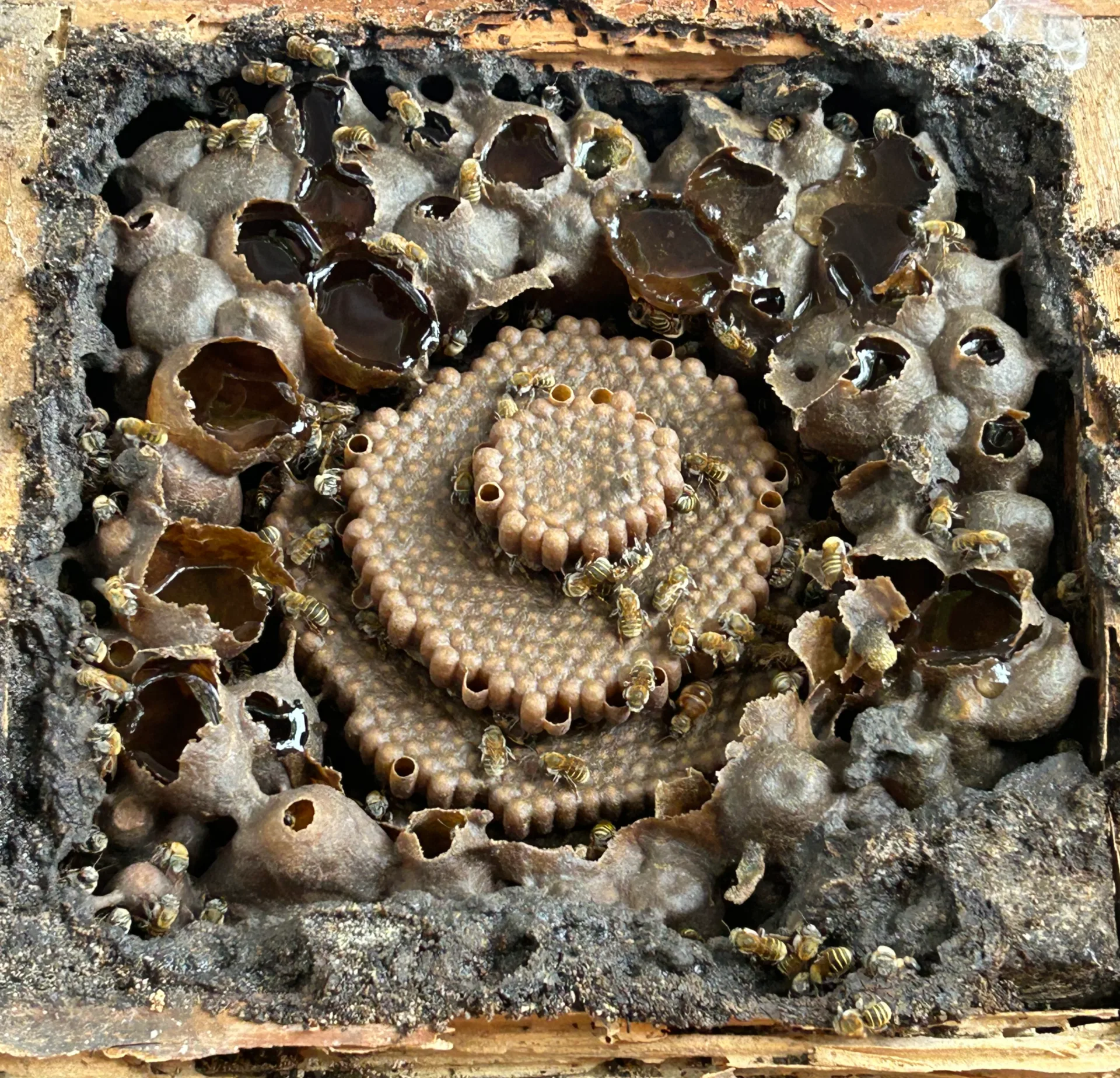
The Fifth Ferment
Hive Fermentation as the Heart of a Living Ecosystem
A forager bee lands on a purple cone flower at dawn. She gathers pollen on her legs, mixing it with nectar and a clear enzyme-rich saliva from her own mouth. The pollen softens. It begins to transform before she even returns to the hive.
She flies back, enters the dark warmth of the colony, and deposits this mixture into a wax cell. Other bees pack it down. A thin layer of honey seals the top.
And then — in the anaerobic darkness, in the 95-degree hum of thousands of bodies — the fermentation begins.
No human has touched this.
No recipe has guided it.
No lab has cultured it.
And yet, what emerges is not chaos.
It is architecture.
It is intelligence.
It is a living system — biological, ecological, and, in its own way, spiritual.
This is hive fermentation. And it is unlike anything else on Earth.
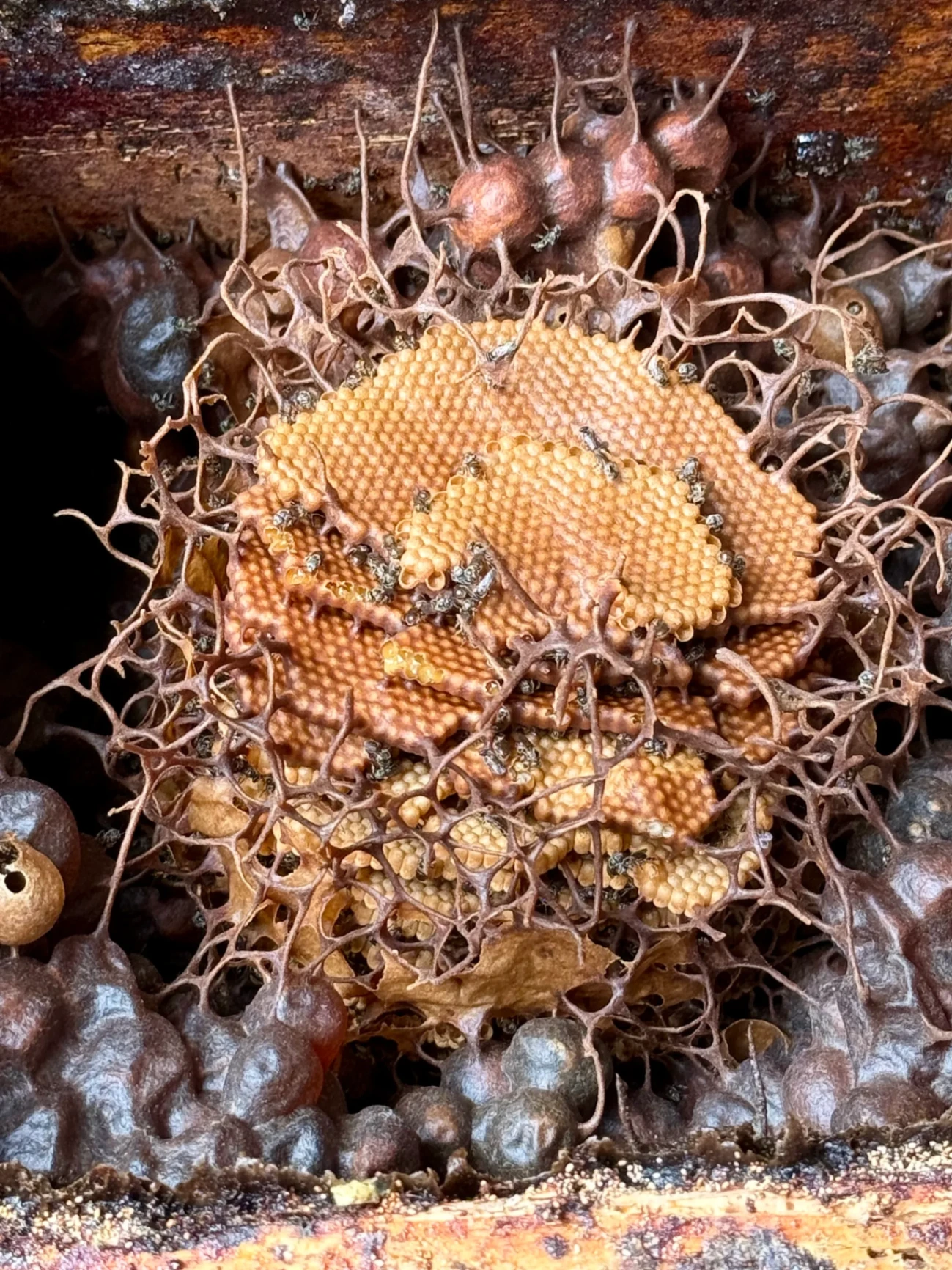
The Hive as a Fermenting Organism
Every other ferment we know is a relationship between human intention and microbial action.
The Hive Ferment is different.
It is a relationship between:
- Insect intelligence — the superorganism of tens of thousands of bees acting as one
- Floral ecosystems — pollen, nectar, resin, and the rhythms of bloom and drought
- Microbial networks — yeasts, lactic acid bacteria, wild fungi carried on wings and petals
- Architectural precision — wax cells, propolis seals, cerumen pots designed for preservation
- Natural chemistry — honey, low oxygen, organic acids working as preservatives
- And time — days, weeks, sometimes months of slow transformation
This is not a simple fermentation. This is an ecological digestive system.
A hive-level gut that intakes raw, wild material from the landscape and transforms it into food capable of sustaining thousands of individuals — including larvae not yet born, and queens not yet crowned.
Whereas human ferments feed a household, Hive fermentation feeds a civilization in miniature.
And like any civilization, the hive cannot survive without it.
When winter comes, when droughts last, when flowers fail — the hive does not starve. It eats from the cells of fermented bee bread, stored like grain in an ancient granary.
This is not improvisation. This is long-term planning by a non-human mind.
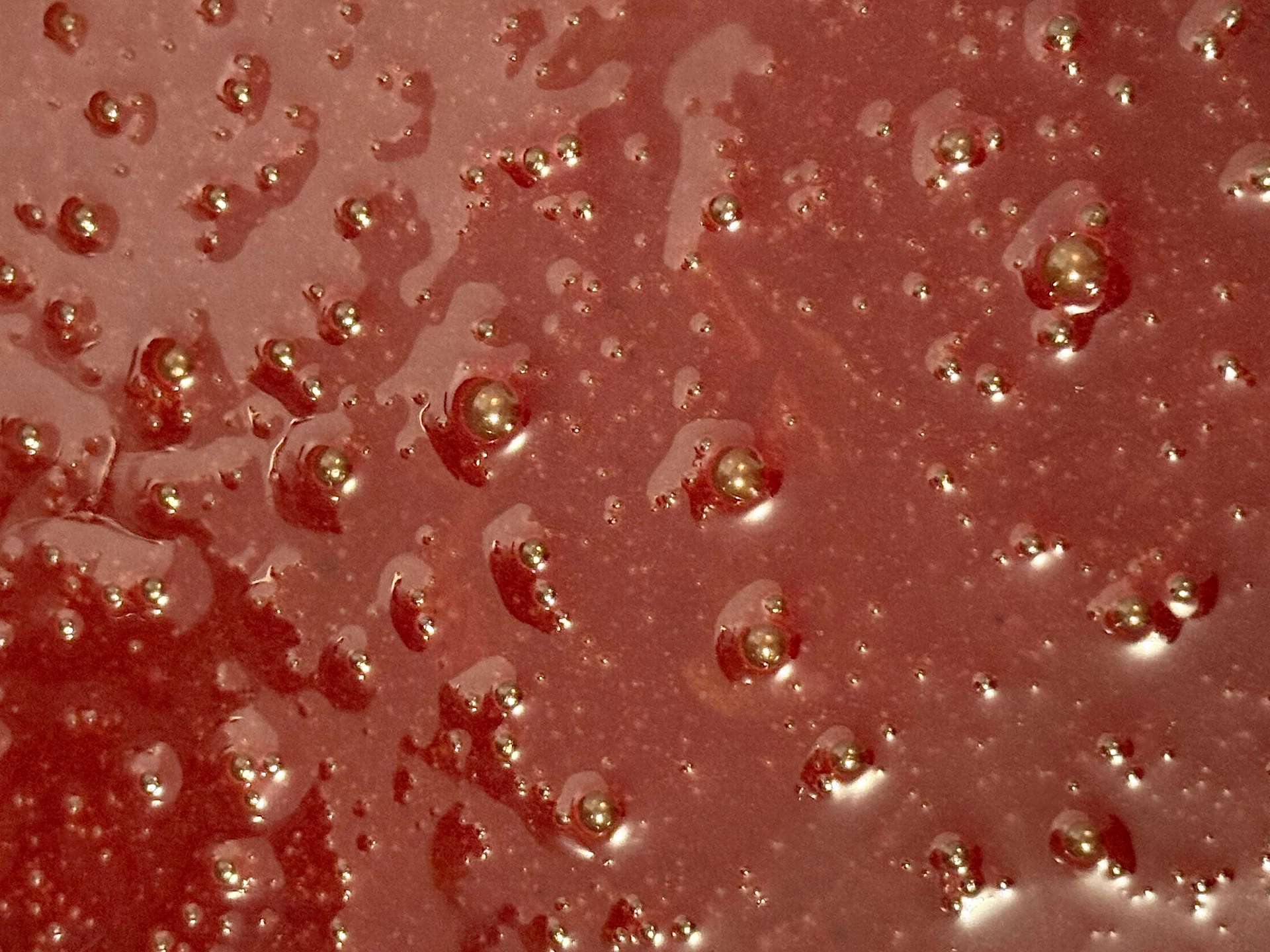
The Hive Gut Made Visible
Here is where hive fermentation becomes profound:
The bee bread is not just food. It is the externalized gut of the hive.
Think about your own gut for a moment.
It is a dark, warm, sealed chamber where trillions of microbes work in concert to:
- Break down food into bioavailable nutrients
- Regulate immunity
- Produce neurotransmitters and hormones
- Store memory in microbial patterns shaped by diet, stress, and environment
- Maintain homeostasis through constant microbial communication
Your gut is your internal ecosystem — your second brain, your immune command center, your living archive.
Now look at the hive.
The fermentation cells — packed with pollen, saliva, honey, and microbes — perform the exact same functions, but for the collective body.
| Function | Human Gut | Hive Ferment |
|---|---|---|
| Nutrient Processing | Breaks down food into absorbable forms | Ferments raw pollen into complete protein, pre-digested by enzymes |
| Immune Defense | Produces antimicrobial compounds, regulates inflammation | Lowers pH with lactic acid, uses propolis phenolics to inhibit pathogens |
| Memory & Identity | Microbial fingerprint reflects diet, health, place | Bee bread encodes seasonal flora, regional soil chemistry, climate patterns |
| Regeneration | Feeds new cells, repairs tissue | Fuels larvae, powers queen fertility, extends colony lifespan |
In both cases, you are not looking at a storage space.
You are looking at a living organ of transformation.
Why This Matters
Hive fermentation reframes the entire story of fermentation.
For too long, we have told a story of human mastery — of humans domesticating microbes, inventing fermentation, spreading civilization through preserved food.
But the bees were fermenting before there were humans. Before there were primates. Before there were mammals.
What we call the Fifth Ferment is not a human invention. It is a gift from the deep past — the oldest living tradition of biological alchemy on the planet.
And it is a gift we can receive, if we remember how to honor it.
References (1)
- [1]
Anderson, Kirk E., et al. 'Microbial ecology of the hive and pollination landscape: bacterial associates from floral nectar, the alimentary tract and stored food of honey bees.' PloS one 8.12 (2013): e83125.
View